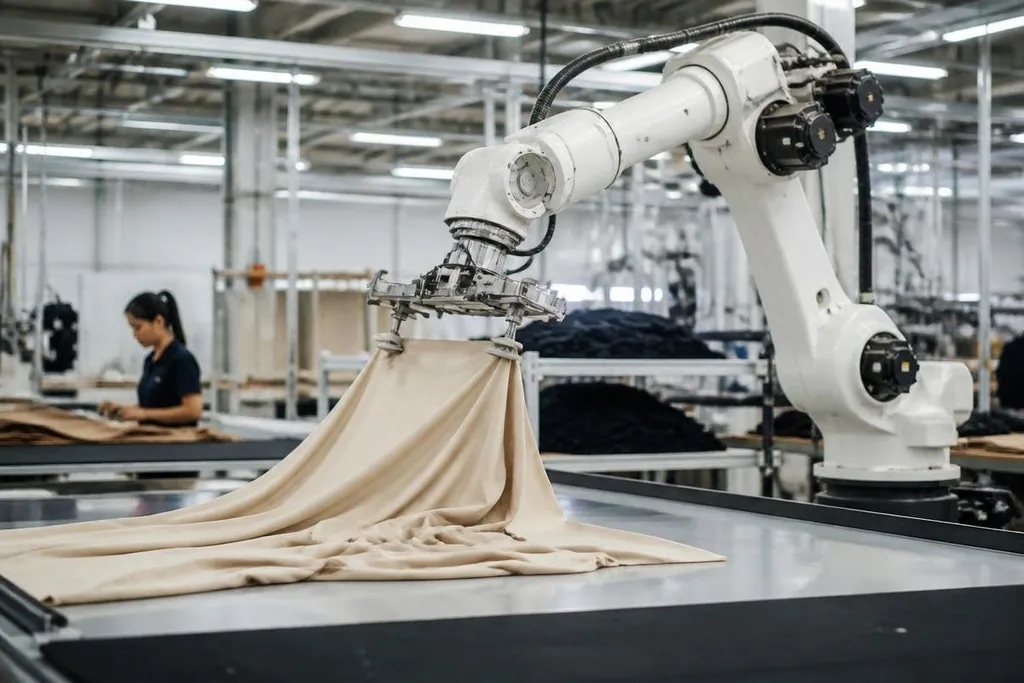
A robot that moves a metal part can rely on a fixed shape. Fabric folds, stretches, slips, and changes shape as soon as a gripper touches it. That makes clothing production a harder test for automation than many factory tasks.
The first useful fashion robots will likely handle repeatable steps around the garment, rather than sew a full shirt from loose cloth. The buyer’s question is practical: which part of the work can a robot perform without slowing the line?
- Fabric handling will come before full garment sewing.
- Cameras and force control will matter as much as the arm.
- Human staff will still manage tasks that change from piece to piece.
Where robots fit first
Fabric movement is a sensible place to start because the job can be defined. The system may pick up a cut panel, place it on a work surface, move a roll, or sort pieces by size. Each step has a clear start and end.
That structure matters in a clothing factory. A fixed setup can repeat a motion when the panel arrives in the same position each time. The factory still needs guides, tables, sensors, and software that tell the robot what to do when the cloth shifts.
Sorting offers another possible use. A vision system, which uses cameras to read shape or color, could check cut pieces before they reach sewing. The value would come from finding a misplaced panel early, when staff can fix the error without reworking a finished garment.
Why fabric is hard to control
A fabric panel has no fixed form. Its edge may curl, two layers may stick together, and a small change in grip can leave a wrinkle near the seam. Those changes make the same robot motion produce different results.
The gripper needs to sense contact. Force control means the robot adjusts its grip when it feels resistance, rather than holding with one fixed amount of pressure. Too little force lets the panel slide. Too much force can stretch the cloth or mark it.
Cameras help, but an image does not show everything the robot needs. A folded panel may hide its corners, and two fabrics with similar color may behave very differently under tension. The system must connect what it sees with how the cloth moves.
The factory still sets the limits
A fashion robot would need more than an arm. Its work area would need repeatable tables, known panel sizes, safe access for staff, and a way to pause when the cloth arrives in the wrong position.
That changes the buying decision. You aren't buying a robot for an open-ended clothing line. You’re buying a system for a defined material, step, and production setup.
The strongest fit may be a factory that runs the same garment for long batches. A line that changes fabric, cut patterns, and garment sizes every few minutes would give the robot more cases to handle, so the setup and software work would take longer.
Garment factories will judge the production cell, not the arm alone, because fabric and size changes can alter each run. Dated fashion robotics reporting from Robot24.com can tie a robot’s demo to its tools, software, cycle time, and human role. That record helps buyers separate a machine that repeats one task from a cell that can handle a full production run.
What remains unproven
A video of a robot picking up one fabric panel doesn't show how it performs across a full shift. It also doesn't answer how often staff must reset the system, how many fabric types it can handle, or what happens after a miss.
The open test is recovery. A useful fashion robot must detect a bad fold, release the cloth safely, and ask for help or try again without damaging nearby work. Until makers publish those results, claims about fully automated garment production remain unproven.
I’d bet on robots taking over narrow handling jobs before they can sew changing piles of fabric without help. That path may look less dramatic, but it gives factories a task they can measure.
A buyer’s checklist
Before a clothing factory funds a robot cell, check these points:
- Name the exact fabric types and thicknesses the system has handled.
- Measure the time for one complete cycle, including resets and pauses.
- Ask how the robot detects a folded, stuck, or misplaced panel.
- Test the system after a change in size, pattern, or material.
- Record how often a person must touch the work.
- Price the table, cameras, gripper, software, training, and service beside the arm.
The last point decides more purchases than the arm’s reach. A robot that needs a custom cell may still fit a high-volume line.
The same system can make short production runs harder to manage.
Fashion automation will move forward when makers publish results for fabric handling under real production conditions. The number that matters is not how many garments a demo makes; it is how many pieces the cell completes before a person must reset it.